A small-business month-end close should confirm that the period is complete, material balances are reconciled, relevant adjustments are recorded and the final figures have been reviewed before management reporting begins. The process needs clear owners, evidence and cut-off dates. A faster close is useful only when it remains reliable and gives management time to act.
What a month-end close should achieve
The close converts day-to-day bookkeeping into a controlled period result. It establishes which transactions belong in the month, whether recorded balances agree with supporting evidence and which estimates or unresolved items remain. The output may be a closed ledger, a trial balance and a file of reconciliations ready for management reporting.
A close is not the same as producing management accounts. Closing establishes a reliable accounting position. Management reporting then compares, analyses and explains that position. The two processes should connect, but their responsibilities and completion criteria should be clear.
Agree what material means for this management process. Not every small difference deserves the same effort, while some unusual or sensitive items need review regardless of value. The policy should reflect the business and should not be confused with statutory audit materiality.
Before month end: prevent the close from starting with a backlog
The fastest improvement often happens before the reporting date. Keep bank-feed items, sales invoices, supplier bills and expense records current during the month. Resolve customer and supplier queries early. Maintain recurring schedules for loans, assets, accruals and prepayments rather than rebuilding them at every close.
Publish a short close calendar that names the information owner and submission date. Operational managers may need to confirm completed work, customer disputes, contractor days or commitments not yet invoiced. The finance team cannot infer those events from bank transactions.
Decide how late information will be handled. The options may include a supported estimate, a clearly disclosed provisional figure or deferral to the next period where appropriate. The treatment should be consistent and approved, not improvised to meet the deadline.
The small-business month-end close checklist
Adapt the checklist to the accounts and reporting basis of the business. Mark an item complete only when the work and supporting evidence are available.
1. Complete transaction capture and apply cut-off
Record sales invoices, supplier bills, expenses, receipts, payments, credit notes and other activity for the period. Review unmatched or excluded bank-feed entries, duplicate transactions and items posted to the wrong date. Confirm whether services delivered but not yet billed or costs incurred but not yet invoiced require an adjustment.
2. Reconcile every active bank and card account
Compare the accounting balance and transactions with the statement for the same date. Investigate differences, uncleared items and changes to previously reconciled transactions. Intuit recommends monthly reconciliation in its QuickBooks guidance and explains that the ending difference should be resolved before the reconciliation is completed.
3. Review sales, customer balances and receivables
Confirm that sales are complete and classified correctly. Agree the receivable ageing report with the ledger and inspect old, negative, disputed or unusually large balances. Identify overdue invoices that need collection action and record credit notes or write-offs only with appropriate approval.
4. Review purchases, supplier balances and payables
Confirm that supplier bills and expenses are recorded for the correct period. Agree payable ageing with the ledger, review old debit balances and identify invoices awaiting approval. Consider costs already incurred where the supplier bill has not arrived.
5. Record payroll and information from other providers
Obtain the payroll journal and supporting summary from the payroll provider, then reconcile related clearing and liability accounts where applicable. Obtain information from tax, legal or other advisers that affects the management accounts. Keep the boundary clear: importing or recording supplied information is not the same as providing the underlying specialist service.
6. Update assets, loans and other supporting schedules
Record material asset additions and disposals, update depreciation where applicable and agree loan balances with lender statements or schedules. Review owner or director balances, deposits, deferred items and other material accounts that may not move through ordinary sales and purchasing workflows.
7. Prepare accruals, prepayments and other adjustments
Update recurring schedules and calculate supported period-end entries. Review earlier accruals and prepayments so obsolete balances do not remain indefinitely. Record the purpose, basis, source and reversal treatment for each material adjustment. Identify estimates clearly.
8. Reconcile material balance-sheet accounts
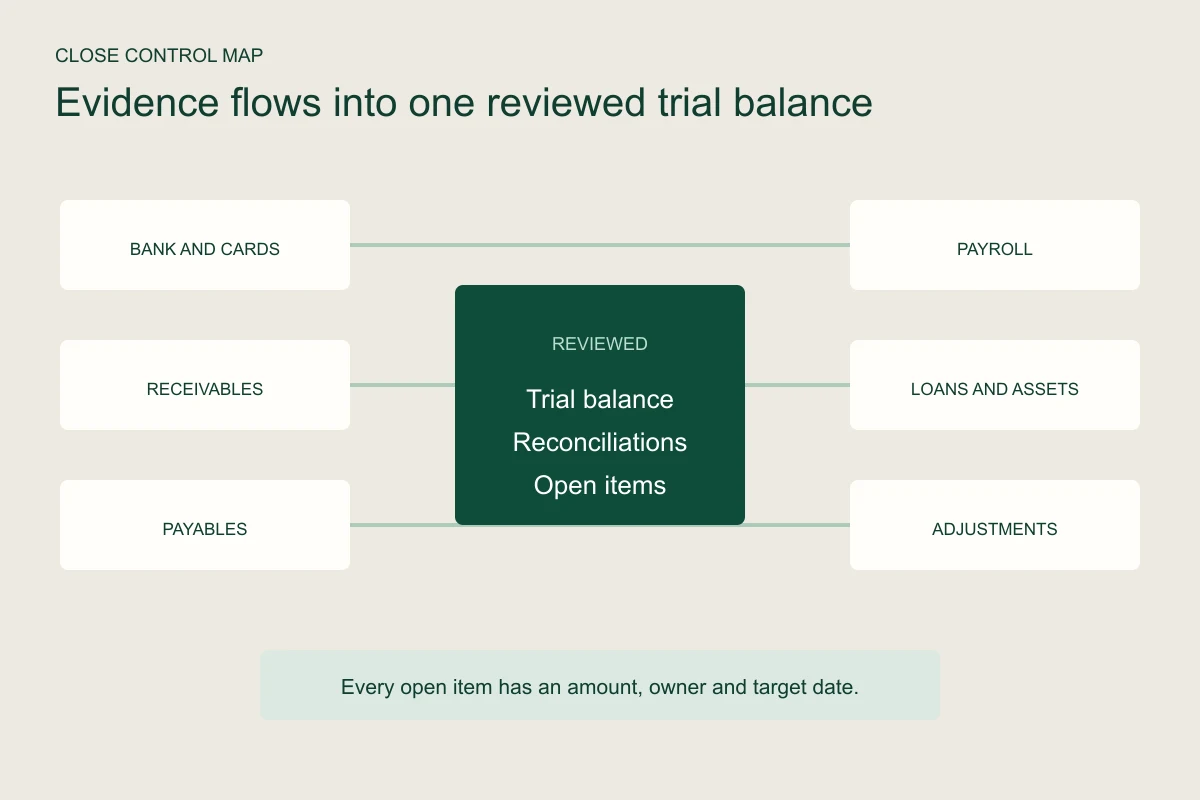
Use a reconciliation that shows the ledger balance, supporting balance, reconciling items and conclusion. Customer, supplier, tax, payroll, loans, assets, suspense and intercompany accounts may require review depending on the business. Assign every open item to an owner and target date.
9. Perform an analytical review
Compare revenue, gross margin, payroll, overheads and material balance-sheet movements with an appropriate prior period or plan. Investigate unexpected changes, round-sum entries and unusual account combinations. Analytical review can identify missing or misclassified items, but it does not replace reconciliation.
10. Review, approve, report and control later changes
A reviewer should confirm that the checklist is complete, material issues are disclosed and the period is ready for reporting. Save the final trial balance, reconciliations and adjustment schedules. Use available closing controls to reduce accidental changes, and document any authorised correction made after the pack is issued.
Example month-end close timetable
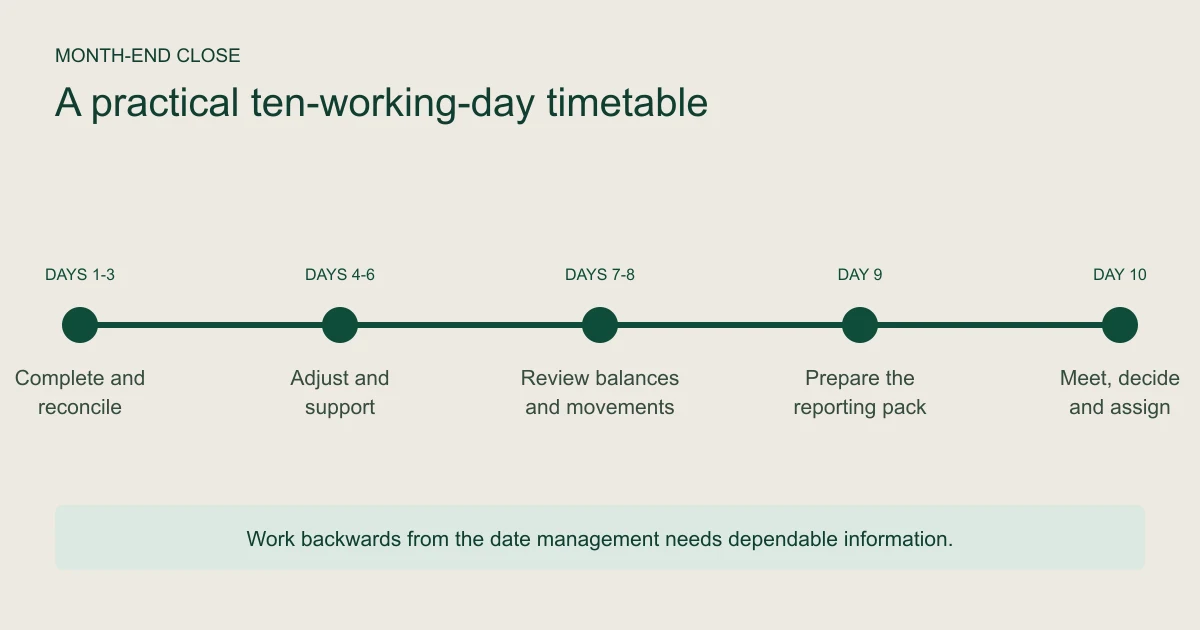
The timetable below is an illustration, not a universal requirement or delivery promise. Work backwards from the management meeting, allow for the volume and complexity of the accounts, and identify critical dependencies.
| Timing | Primary activities | Expected output |
|---|---|---|
| Before month end | Maintain records, update recurring schedules and confirm responsibilities | Limited backlog and known dependencies |
| Working days 1 to 3 | Complete capture, cut-off, bank and card reconciliations | Transaction record substantially complete |
| Working days 4 to 6 | Review receivables, payables, payroll, assets, loans and adjustments | Supported period-end entries |
| Working days 7 to 8 | Reconcile material balances and perform analytical review | Reviewed trial balance and open-items list |
| Working day 9 | Prepare management pack and commentary | Draft reports and proposed actions |
| Working day 10 | Management review and action log | Decisions, owners and dates |
Assign responsibilities before the close begins
A checklist without ownership becomes a reminder list. Name who prepares the work, who supplies information, who reviews it and who approves the final pack. One person may hold several roles in a small business, but the responsibilities should still be explicit.
| Responsibility | Possible owner | Evidence of completion |
|---|---|---|
| Transaction completeness | Bookkeeper or accounts support | Exception review and submission checklist |
| Operational cut-off information | Business owner or department lead | Written confirmation and supporting schedule |
| Reconciliations and adjustments | Accountant or assigned preparer | Signed or dated close schedules |
| Review and unresolved issues | Reviewer or finance lead | Review notes and open-items log |
| Management decisions | Owner or leadership team | Action log with owners and dates |
Common month-end close problems and practical fixes
Measure improvement through reliability as well as speed. Useful indicators include the reporting date, number of unresolved reconciling items, value of late adjustments, repeated review points and actions completed from the previous meeting.
Information arrives late
Move submission dates into a shared calendar, use a standard request list and escalate missing items before the reporting deadline. If an estimate is used, document the basis and replace or reverse it through a controlled process.
Reconciliations restart from zero each month
Use a standard schedule with the prior closing balance, current movement and open items. Resolve old differences instead of carrying them forward without an owner. Keep evidence with the schedule.
The close depends on one person
Document the sequence, file locations, account ownership and review criteria. Cross-train another person on critical steps. Reduce avoidable manual copying, but retain visible controls over imported or automated data.
Reports change after they are issued
Use a final version label, close-period controls and a correction log. Explain the reason and effect of a later change to anyone who relied on the earlier pack. Frequent changes indicate an upstream completeness or review problem.
Improve the close before adding more reports
Irish Accounting Partner can help a small business document the close, improve reconciliations, organise responsibilities and connect the final ledger to monthly management reporting. The scope can cover one process problem or recurring accounting and reporting support.
A consultation begins with the current timetable, recurring delays, account structure and reports management needs. Our services do not include tax compliance, payroll, statutory audit, internal audit or independent assurance.
Make month end dependable before making it faster.
Tell us where the close stalls, which balances are difficult to reconcile and when management needs the final reports.
Request a consultation