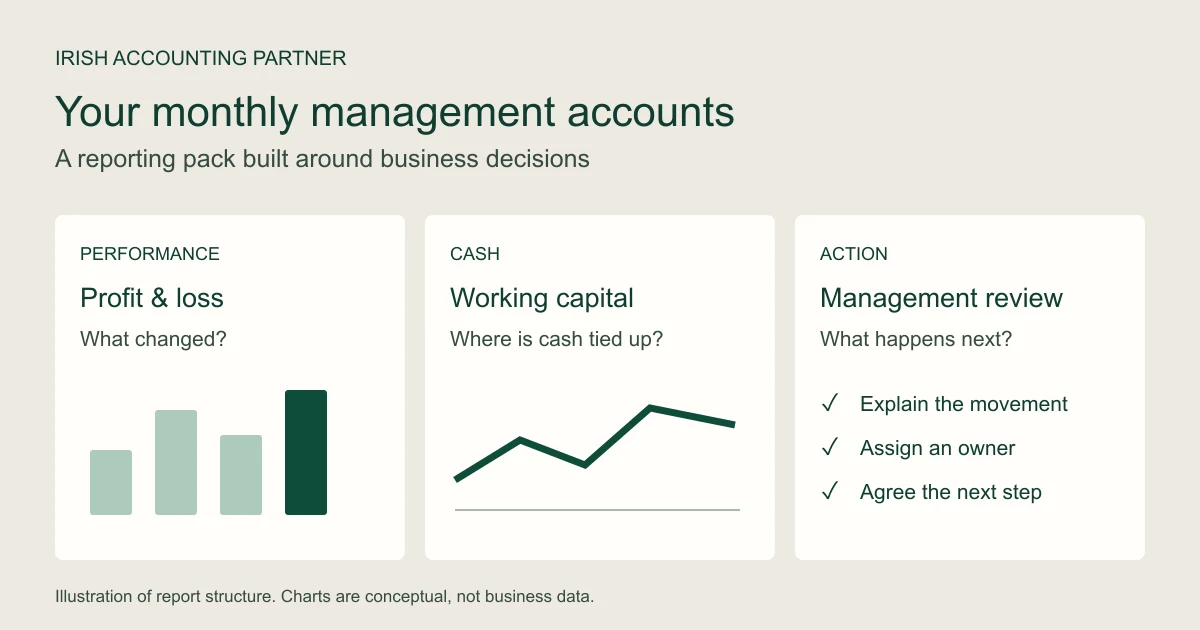
Monthly management accounts should explain how the business performed, where cash is tied up, what changed against the plan and which decisions need attention. A useful pack combines a profit and loss account, balance sheet, cash information, relevant comparisons, a small set of KPIs and clear management commentary.
What are management accounts?
Management accounts are financial reports prepared during the year to help owners and managers run a business. The reporting period, level of detail and measures should reflect the decisions being made. A consultancy managing project margins needs a different pack from a startup monitoring runway.
There is no single prescribed management accounts template for every Irish business. ThinkBusiness describes management accounts as flexible internal reports whose format and frequency depend on the information needed. That flexibility is useful, provided definitions remain consistent from month to month.
Start with the questions the management team needs answered: Are we earning enough on our work? Why is cash lower? Can we afford the next hire? Which costs need investigation? Each part of the pack should help answer one of those questions.
How they differ from bookkeeping and annual accounts
Bookkeeping records and organises transactions. Management accounts use those records, period-end adjustments and operational information to explain performance. An annual set of accounts covers a completed financial year and serves a different reporting purpose. Management reporting does not replace statutory obligations.
A bank feed or unadjusted software profit and loss report is a starting point. Missing supplier invoices, unpaid work, prepayments or an unreconciled bank balance can change the picture. The quality of the monthly pack depends on the quality of the underlying records and close process.
If bookkeeping is up to date but managers still cannot explain margin changes or plan commitments confidently, reporting and analysis may be the missing layer. You can combine the two services while keeping their responsibilities clear.
What a monthly management accounts pack should contain
Use the following as a sample contents page. Agree which elements are needed, who prepares them and when the pack must reach management. A short pack with supporting schedules is often easier to use than an unfiltered ledger export.
| Part of the pack | What it should show | Question it answers |
|---|---|---|
| Management summary | Important changes, risks and decisions | What needs attention now? |
| Profit and loss | Month and year-to-date results with comparisons | Are we earning enough? |
| Balance sheet | Assets, liabilities and supporting reconciliations | What do we own and owe? |
| Cash and working capital | Cash movements, receivables and payables | Why has available cash changed? |
| Budget and variance analysis | Actual results against an agreed baseline | Where did performance differ from plan? |
| KPIs | A few defined financial and operational measures | What is driving the results? |
| Commentary and actions | Causes, implications, owners and dates | What will we do next? |
1. Profit and loss: explain revenue, costs and margin
Show revenue, direct costs, gross profit, operating expenses and the resulting profit or loss for the month and financial year to date. Compare these with the budget and a relevant earlier period. A seasonal business may learn more from the same month last year than from the immediately preceding month.
Separate meaningful revenue streams and cost categories. For an agency, revenue by project or client and associated delivery costs can reveal work that looks busy but contributes little margin. Keep the allocation method consistent and explain changes to it.
Account for relevant accruals, prepayments, depreciation and revenue cut-off before drawing conclusions. A large insurance payment should not automatically make one month look unusually expensive if the cost relates to several months. Show unusual items clearly so managers can distinguish recurring performance from one-off effects.
2. Balance sheet: show what sits behind the profit
Include the period-end bank position, customer balances, supplier balances, borrowing, fixed assets and other material assets and liabilities. Compare important balances with the previous period and explain significant movements.
Support material balances with reconciliations and schedules. Customer and supplier ageing reports should agree to the ledger. Loan schedules should explain movements in borrowing. An old suspense balance deserves investigation even when the current month looks profitable.
Identify estimates, unresolved differences and late information. If a pack is provisional, say what remains open and whether it could materially change the result. A precise-looking total can give false confidence when the underlying accounts have not been reviewed.
3. Cash and working capital: explain the bank movement
Show opening cash, receipts, payments and closing cash, with an explanation of the main movements. Profit and cash measure different things: an invoice can contribute to revenue before the customer pays, while a loan repayment can use cash without being an operating expense.
Include overdue customer invoices, payments falling due and any significant cash commitments. Explain whether customer concentration, disputed invoices or changes in payment timing are increasing pressure. For businesses carrying stock, inventory movements also affect the amount of cash tied up.
A historical cash summary explains what happened. A forecast estimates what may happen next. Where liquidity needs active management, attach or link a rolling cash forecast with explicit assumptions. A 13-week forecast can support weekly cash decisions, but it is not a mandatory component of every monthly engagement.
4. Budget and variance analysis: distinguish timing from a real change
Compare actual results with the approved budget or an explicitly identified forecast. Keep the original budget visible when it remains the performance benchmark. Quietly replacing it with a revised forecast can hide how far the business has moved from its plan.
Explain both the euro difference and the percentage difference where the comparison is meaningful. When the baseline is zero or very small, a percentage can mislead. Use the absolute movement and a plain explanation instead.
Investigate whether a difference comes from volume, price, service mix, delivery efficiency, timing or a recording error. If revenue is below budget because an invoice is late, the next step differs from a shortfall caused by a lost client.
Agree investigation thresholds suited to the business. For example, management might review expense movements exceeding both €1,000 and 10%, while separately investigating unusual transactions regardless of size. Those figures are an illustration, not a universal materiality rule. Qualitative concerns can matter even when amounts are small.
5. KPIs: connect accounting results with the work being done
Choose measures that management can interpret and act on. Define each measure, identify its data source and assign responsibility for updating it. A changing definition makes month-to-month trends unreliable.
An agency or consultancy might monitor project gross margin, billable utilisation, unbilled work and overdue receivables. A startup may need monthly cash burn, runway and revenue against its funding plan. Use the measures relevant to the business rather than including every available dashboard metric.
Gross margin percentage is gross profit divided by revenue. If you report debtor days or utilisation, document the exact convention and period used. For runway, explain whether the calculation uses historical average burn or a forward forecast. Hiring, seasonality and planned investment can make a simple historical average unsuitable.
6. Management commentary: turn the report into decisions
Commentary should explain the movement, the likely cause, its financial effect and the proposed response. Separate a confirmed explanation from something that still needs investigation. Repeating that revenue fell by 10% adds little if the table already says so.
A useful comment might read: “Delivery costs increased because two projects required additional contractor days. Review the remaining project budgets before accepting further work at the current price.” The next action should name an owner and an agreed date.
Keep a short action log and revisit it at the next meeting. If collections were the priority last month, show whether the overdue invoices were paid. A monthly review becomes more useful when decisions and follow-through remain visible.
Worked example: profitable trading, falling cash
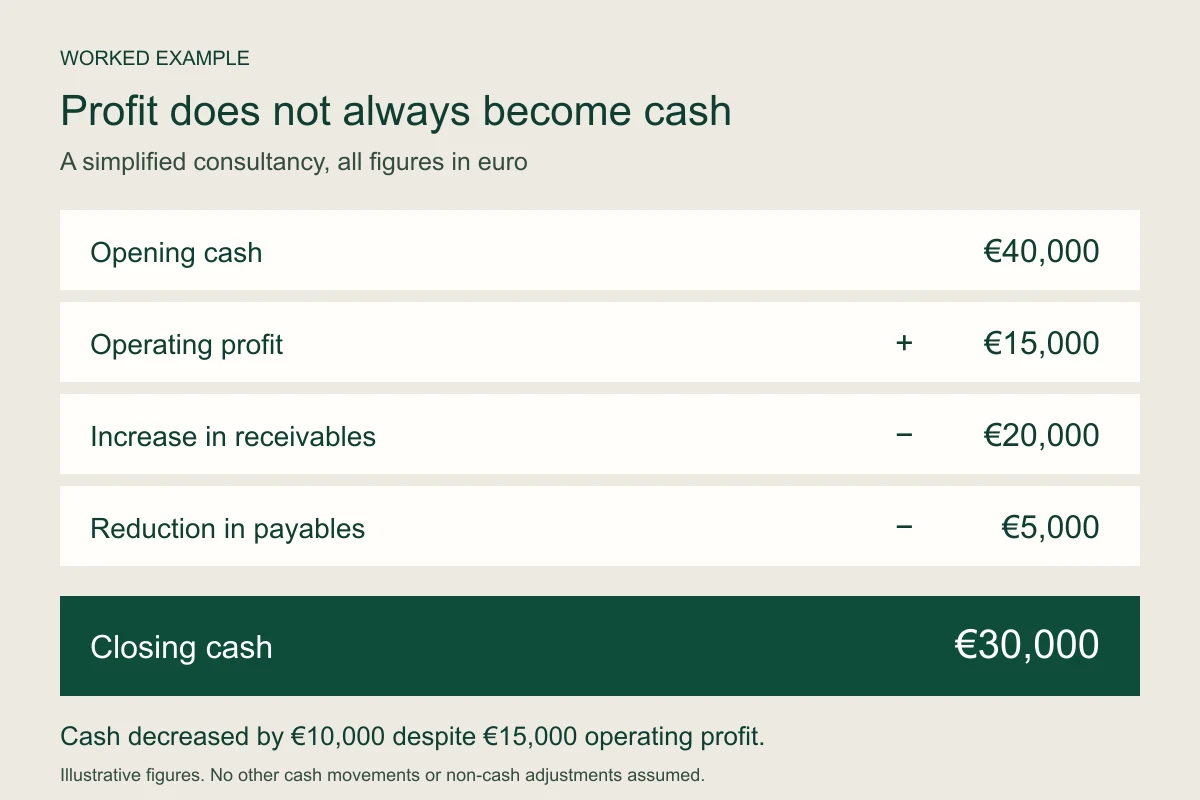
Consider this simplified illustrative consultancy. These are fictional figures, not client results. Revenue is €80,000 and operating costs are €65,000, producing €15,000 operating profit. Compared with budget, both revenue and profit are lower.
During the same month, customer receivables rise by €20,000 and supplier payables fall by €5,000. Assuming no other cash movements or non-cash adjustments, cash falls by €10,000: €15,000 profit less €20,000 additional receivables less €5,000 reduction in payables. Opening cash of €40,000 therefore becomes €30,000.
The practical conclusion is that profitable trading has not translated into cash receipts. Management should investigate collection dates and review upcoming payments before committing the apparent profit to new spending. In a real business, the reconciliation would also consider relevant tax, investment, borrowing and other movements.
| Measure | Budget | Actual | Actual less budget |
|---|---|---|---|
| Revenue | €90,000 | €80,000 | −€10,000 |
| Operating costs | €70,000 | €65,000 | −€5,000 |
| Operating profit | €20,000 | €15,000 | −€5,000 |
What information is needed, including QuickBooks records?
The starting point is a complete accounting record for the period. QuickBooks can provide underlying ledger reports, but the pack still needs appropriate coding, reconciliations, adjustments and interpretation. Available reporting features depend on the product and subscription, so agree the working format before promising a particular dashboard.
Agree a cut-off for submissions and a list of responsibilities. Management needs to explain operational events and supply information that the accounting software cannot infer, such as unfinished work, contract changes or a customer dispute.
- Bank and payment-provider statements, reconciled to the ledger.
- Sales invoices, supplier bills, credit notes and expense records for the period.
- Receivable and payable ageing, including disputed or overdue balances.
- Payroll journals supplied by your payroll provider, loan schedules and relevant asset records.
- Accruals, prepayments, work in progress and other adjustments where applicable.
- The agreed budget or forecast and operational data used for KPIs.
Monthly or quarterly, and how soon after month end?
Monthly reporting is useful when trading, staffing or commitments change frequently. Quarterly reporting may suit a simpler, more stable business, provided cash and urgent issues are monitored between reporting dates. Frequency should follow the pace of decisions.
Agree the reporting deadline backwards from the management meeting. A possible timetable is records submission in the first few working days, followed by reconciliations, adjustments and review, with a pack available around working day ten. This is an example of a timetable to agree, not an industry requirement or a delivery promise.
Reports arriving after the relevant decision has been made have limited value. If the close is consistently late, address missing inputs, unclear ownership or manual reconciliations. Do not shorten the timetable by hiding unresolved differences.
A checklist for your next monthly finance meeting
Use these questions to review the pack with whoever prepares it. Save or print this page to keep the checklist alongside your monthly reports.
- Is the reporting period clear, with provisional figures identified?
- Do the bank and material balance-sheet accounts reconcile?
- Can we explain the main revenue, cost and margin movements?
- Are actual results compared with a clearly named budget or forecast?
- Do we understand the difference between profit and the movement in cash?
- Which overdue invoices and upcoming payments need action?
- Are KPI definitions consistent and their data sources reliable?
- What decision follows from each significant issue?
- Does every agreed action have an owner and date?
- Did we follow through on the actions from the previous meeting?
Signs your reporting pack needs improvement
Common warning signs include an unchanged commentary month after month, unexplained suspense balances, missing cash information and KPIs that cannot be traced to a consistent source. A pack can also be technically accurate yet too late or too detailed to support a useful discussion.
Start by identifying the gap. Incomplete records call for bookkeeping or accounting work. Reliable accounts without interpretation call for management reporting. Recurring decisions about hiring, pricing, funding and investment may justify senior finance involvement. More pages alone will not resolve unclear ownership or poor data.
Building a reporting pack around your business
Irish Accounting Partner provides management accounts and performance reporting for businesses across Ireland. Our Dublin 8 team can agree the required reports, comparison basis, inputs and review rhythm around how your business operates.
If you already have a bookkeeper, the first step may be to improve the monthly close and add reporting. If you already receive a pack, the discussion can focus on what is missing from it. The scope of any work is agreed before an engagement begins.
This guide provides general information. Examples are illustrative and the appropriate reporting approach depends on the business. Our services do not include tax compliance, payroll, statutory audit or independent assurance.
Make your monthly reports more useful.
Tell us what you receive today and which decisions you need the numbers to support.
Request a consultation