A bookkeeper maintains reliable transaction records, a management accountant turns financial and operational data into internal reporting, and a Virtual CFO provides recurring senior input into planning and commercial decisions. A business may need one layer, a combination of layers or a staged transition. The right choice depends on the problem to solve, not the prestige of the title.
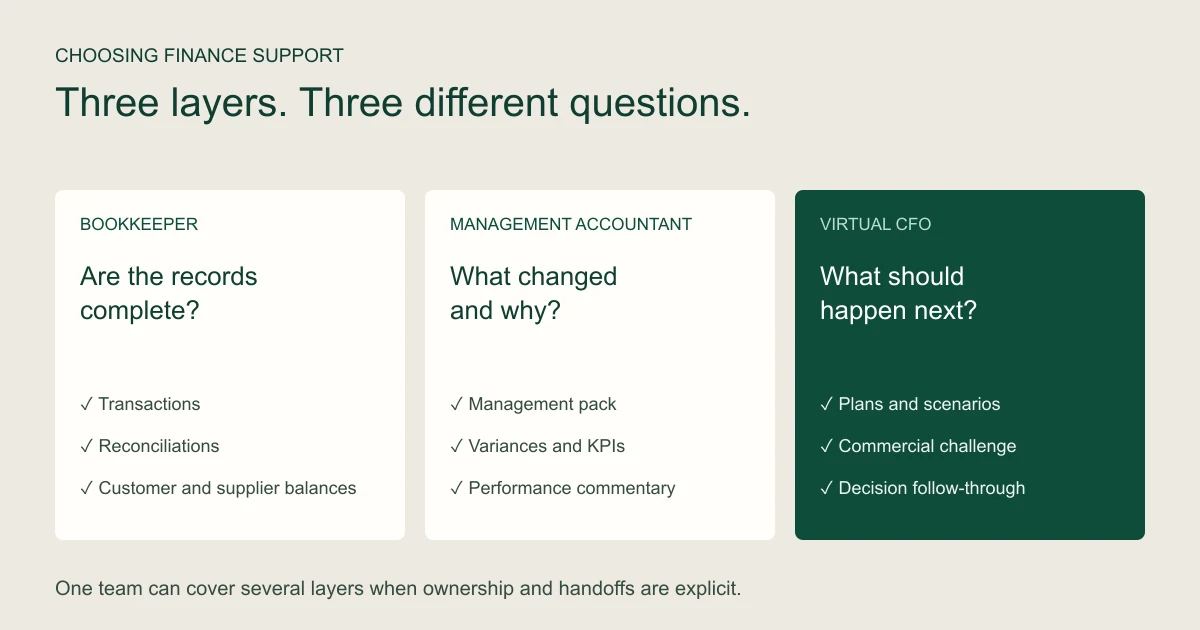
Bookkeeper, management accountant and Virtual CFO compared
Job titles vary between providers. Compare the promised responsibilities, outputs and review rhythm rather than relying on the label alone. The table describes a common small-business division of work, not a regulated definition of every engagement.
| Area | Bookkeeper | Management accountant | Virtual CFO |
|---|---|---|---|
| Primary focus | Complete and organised records | Performance, cash and internal reporting | Planning, priorities and financial implications |
| Typical outputs | Ledgers, reconciliations, receivable and payable records | Management pack, variances, KPIs and commentary | Forecasts, scenarios, decision papers and management follow-through |
| Main time horizon | Transactions already completed | Current and recent performance | Current position and future choices |
| Typical question | Are the books complete and reconciled? | What changed and why? | What should the business do next? |
| Common rhythm | Weekly or monthly processing | Monthly or quarterly reporting | Recurring meetings plus decision-led work |
What a bookkeeper does
A bookkeeper records and organises financial activity. The scope may include sales invoices, supplier bills, expenses, bank transactions, payment records, reconciliations and maintenance of customer and supplier balances. A strong bookkeeping process produces a ledger that can be reviewed and used by management and other appointed advisers.
Bookkeeping is the right starting point when accounts are behind, balances do not reconcile, documents are missing or the owner is spending too much time on routine records. It can also remain the main recurring requirement for a simple business whose management questions are limited.
Bookkeeping does not automatically include period-end adjustments, management commentary, forecasting or advice on commercial choices. Some providers include these services, but the engagement should state them. Reliable records are necessary for every higher layer, so skipping bookkeeping problems and moving directly to a dashboard rarely works.
What a management accountant adds
A management accountant prepares and analyses internal financial information for planning, performance evaluation and decision-making. ACCA describes the role as using financial data to guide decisions, plan budgets and improve business performance. Typical work includes monthly management accounts, budgets, forecasts, performance analysis and communication of financial information to non-finance managers.
The reporting process normally begins after the underlying records are complete enough to close the period. It may add accruals, prepayments, depreciation, cut-off adjustments and supporting reconciliations. The management accountant then compares results with a budget, forecast or prior period and explains significant movements.
This layer is useful when the books are up to date but management cannot explain margin, working capital, cost changes or performance by project or department. It turns the accounting record into a repeatable discussion about what happened and what needs attention.
What a Virtual or Fractional CFO adds
Virtual CFO and Fractional CFO usually describe recurring senior finance support supplied without a full-time in-house appointment. The exact title is less important than the scope. Work may include financial planning, scenario analysis, cash oversight, management meeting participation, challenge of assumptions and coordination of the wider finance process.
A Virtual CFO should not spend the entire engagement rebuilding unreconciled books. Reliable accounting and reporting still need clear owners. Senior input is most useful when management has recurring decisions about hiring, pricing, investment, funding, delivery capacity or risk and needs someone to connect those decisions with the financial position.
This service does not replace legal, tax, investment or audit advice. It should also avoid vague promises of strategy without defined outputs. Agree the meeting rhythm, decisions in scope, information required, actions owned by the provider and responsibilities retained by management.
Which level of support does your business need?
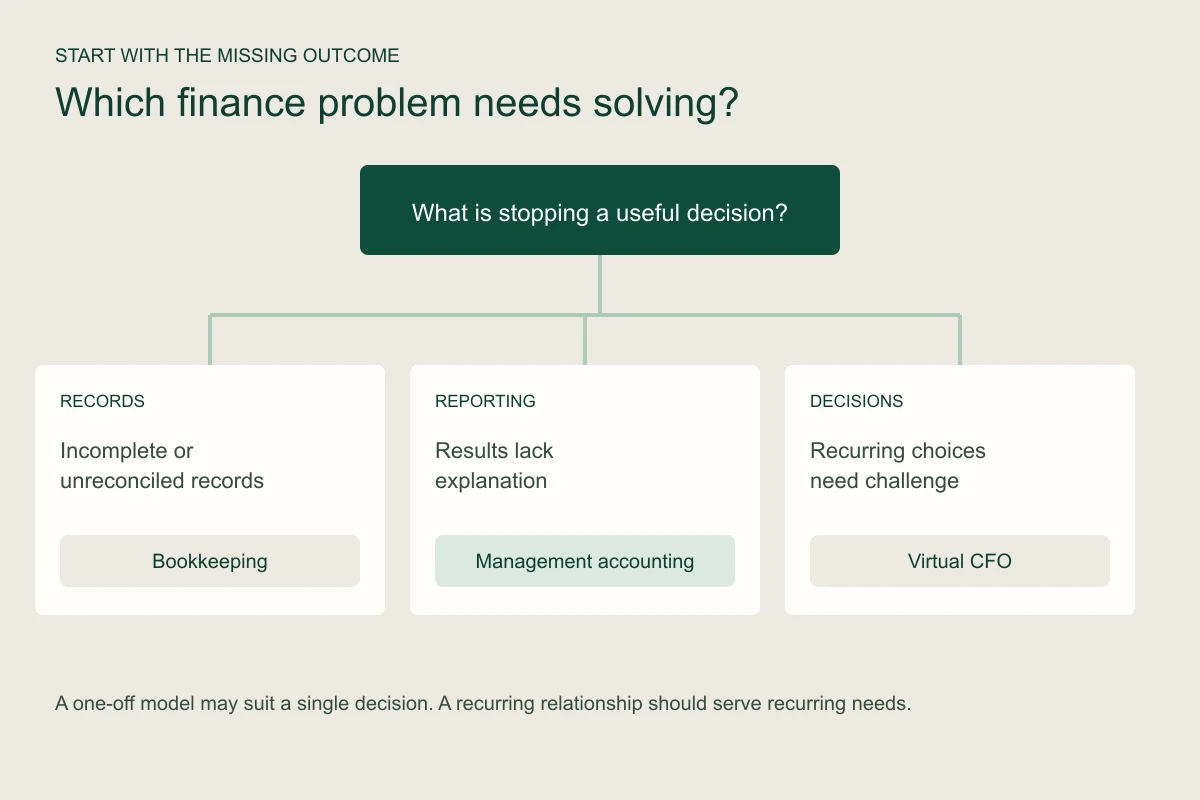
Work from the immediate management problem. Several symptoms may point to the same root cause, and one engagement can combine compatible responsibilities.
Choose bookkeeping support when the records are the problem
Prioritise bookkeeping when transactions are incomplete, bank or card accounts do not reconcile, customer and supplier balances are unreliable or documents are hard to locate. Set a clean-up scope if historic work is required, then agree the recurring process that prevents the backlog returning.
Choose management accounting when interpretation is the problem
Add management accounting when the books are credible but reports are late, too broad or unexplained. The output should identify useful comparisons, movements, KPIs and actions. It should also state where figures are provisional or dependent on estimates.
Choose Virtual CFO support when recurring decisions need senior financial input
Consider a Virtual CFO relationship when management is making connected choices about resources, cash, funding and growth. The need should recur often enough to justify a rhythm of preparation, meetings and follow-through. A one-off financial model may be more proportionate for a single defined decision.
Can one outsourced team cover all three layers?
Yes, an outsourced accounting team can cover records, reporting and senior support if responsibilities and review controls are explicit. It can also work alongside an existing bookkeeper, tax adviser or internal administrator. The practical requirement is a clear handoff from transaction processing to close, from close to reporting, and from reporting to decisions.
Ask who owns each bank reconciliation, adjustment, report, forecast assumption and action. Confirm which software is used, when information is due and what happens if it arrives late. The person who reviews the management pack should not assume that a dashboard has already been checked simply because it came from accounting software.
A combined scope should still be proportionate. Start with the minimum recurring output that management will use, then widen it when a real decision or control requirement appears.
- Records owner: transaction completeness and reconciliations.
- Close owner: adjustments, cut-off and supporting schedules.
- Reporting owner: comparisons, KPIs and commentary.
- Management owner: operational explanations and decisions.
- Senior finance owner: assumptions, challenge and agreed follow-through.
Questions to ask before appointing finance support
A clear engagement answer is more useful than a long service list. Ask for examples of the process and deliverables, but do not expect access to confidential client information.
- What problem will the first phase solve?
- Which records and accounts will be maintained or reviewed?
- What reports, forecasts or meeting outputs will be delivered?
- Who supplies operational information and by what date?
- How are unresolved differences and estimates disclosed?
- Which decisions are inside and outside the scope?
- How will work coordinate with tax, legal, payroll or audit advisers?
- What changes the fee or requires a revised scope?
Start with the smallest useful finance outcome
Irish Accounting Partner provides bookkeeping, management accounts, forecasting, financial modelling and Virtual CFO support to businesses across Ireland. The work can begin with one focused requirement or connect several finance layers under an agreed scope.
Tell us where the current process stops being useful. We can distinguish a records gap from a reporting gap and a recurring senior finance requirement. Our services do not include tax compliance, payroll, statutory audit, internal audit or independent assurance.
Choose support by outcome, not by job title.
Describe the records, reports or recurring decisions that need attention and we will help define a proportionate starting point.
Request a consultation