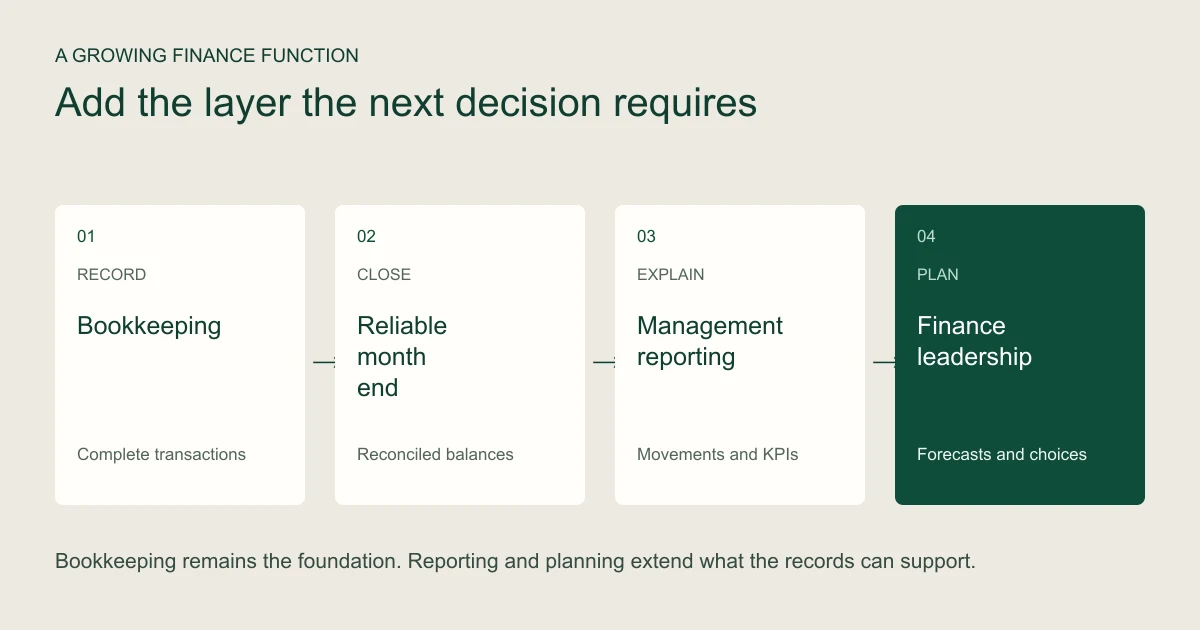
A business has usually outgrown bookkeeping alone when accurate transaction records no longer answer the questions management must act on. Bookkeeping remains essential, but the business also needs a reliable month-end close, management accounts, cash-flow forecasting or senior finance input. The clearest signal is not turnover or headcount by itself. It is a recurring gap between the information available and the decisions being made.
What bookkeeping should do before you add another layer
Bookkeeping should provide a complete and organised record of sales, purchases, receipts, payments and other transactions. Bank and card accounts should be reconciled, customer and supplier balances should be credible, and supporting documents should be available. Without that foundation, management reporting can produce polished but unreliable answers.
Outgrowing bookkeeping does not mean that the bookkeeper has failed. It means the management task has changed. A growing company may need to explain margin by service line, forecast cash before hiring, compare actual results with a plan or prepare information for a lender. Those questions require analysis, assumptions and management context as well as transaction processing.
Before changing providers, separate a records problem from a reporting problem. If transactions are missing or balances do not reconcile, strengthen bookkeeping and the close first. If the books are dependable but the owner still cannot explain what changed or what comes next, add a reporting or planning layer.
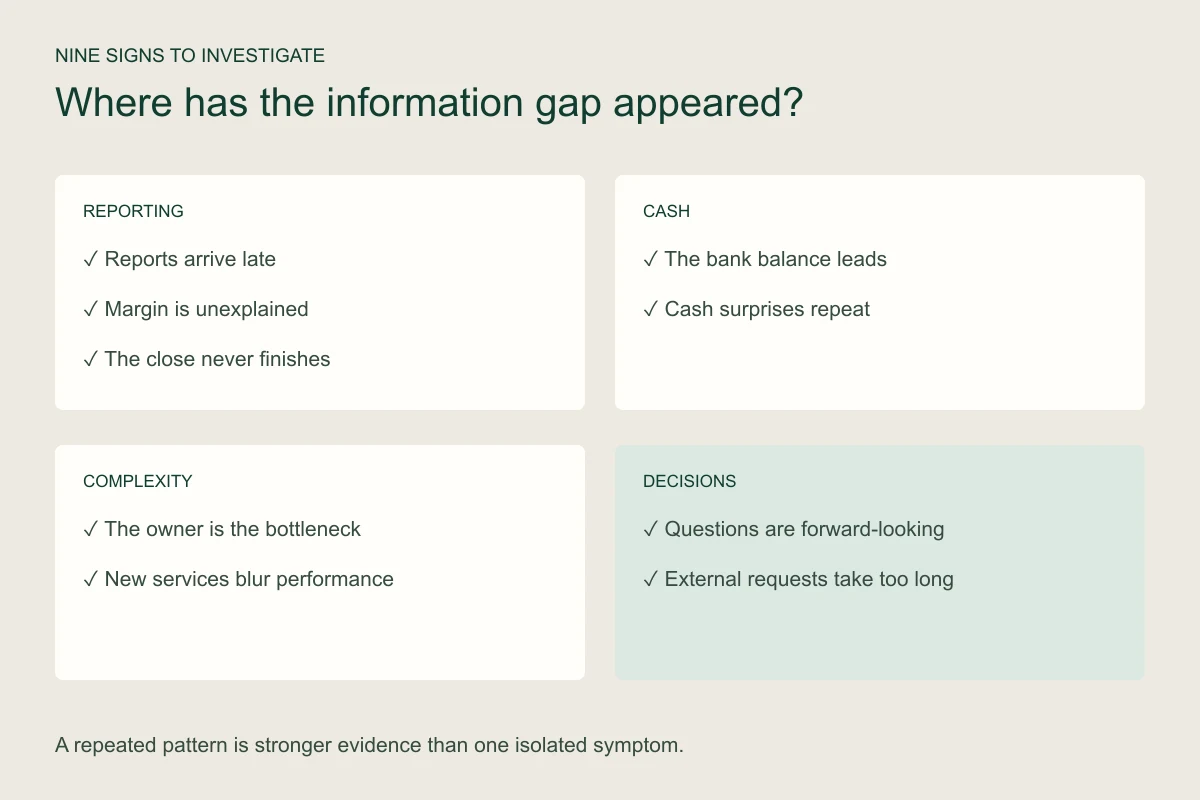
9 signs your business has outgrown bookkeeping alone
One symptom can have a simple explanation. A pattern across reporting, cash and decision-making is more persuasive. Use the signs below as prompts for a conversation, not as an automatic instruction to buy a larger finance package.
1. Financial reports arrive after the decision
A profit and loss report produced long after month end may be historically correct but commercially late. If pricing, staffing or spending decisions have already been made, the report cannot influence them. The next requirement is often a documented close timetable with clear submission dates, reconciliations, review steps and an agreed reporting date.
2. The bank balance has become the main management report
Cash in the bank matters, but it does not show unpaid customer invoices, supplier commitments, upcoming repayments or whether current trading is profitable. When owners repeatedly check the bank balance to decide what the business can afford, they usually need a cash forecast and a clearer working-capital view.
3. Revenue is visible but margin movements are not
A growing sales figure can hide lower prices, higher delivery costs or an unprofitable service mix. Management accounts should separate useful revenue and cost categories, apply consistent allocation rules and explain the drivers of gross margin. For agencies and consultancies, project or client economics may matter more than total revenue alone.
4. Profitable months still create cash surprises
Profit and cash move differently. Revenue may be recognised before a customer pays, while loan repayments and asset purchases use cash in ways that do not appear as ordinary operating expenses. If the reason for a falling bank balance is regularly unclear, management needs a profit-to-cash explanation and a forecast of upcoming receipts and payments.
5. The owner is the only person who can explain the numbers
When reporting depends on one person remembering every customer issue, contractor commitment and exceptional cost, the finance process is fragile. A useful monthly process records definitions, responsibilities, explanations and actions so another manager can understand the position without reconstructing it from memory.
6. The month-end close never feels complete
Late bills, unreconciled accounts, old suspense balances and repeated changes to prior months make comparisons difficult. Better reporting starts with a close checklist and a controlled treatment for missing information. A provisional figure should be identified clearly, together with what remains open and whether it could materially change the result.
7. New services, projects or team members have increased complexity
More activity does not automatically require a senior finance function, but complexity often does. Multiple revenue streams, delivery teams, funding milestones or significant contractor costs can make a single company-wide profit figure inadequate. The chart of accounts and reporting dimensions should reflect how management actually runs the business.
8. Important questions are about the future
Bookkeeping explains transactions that have happened. Hiring, investment, funding and runway decisions require assumptions about what may happen. When management is asking whether cash will cover the next quarter or how a delayed contract changes the plan, forecasting and scenario analysis become part of the finance requirement.
9. Advisers or funders keep asking for information you cannot produce quickly
A lender, investor, board member or external adviser may request current results, forecasts, supporting schedules or explanations of performance. Rebuilding these for every request wastes time and increases inconsistency. A recurring reporting pack creates a controlled starting point, while specialist tax, legal or audit work remains with the appropriate adviser.
Match the information gap to the right support
Do not jump from basic bookkeeping to a broad Virtual CFO engagement simply because the business is growing. Start with the missing outcome and add the smallest sensible layer.
| Current problem | Capability usually missing | Possible starting point |
|---|---|---|
| Transactions or reconciliations are incomplete | Reliable records and balance control | Bookkeeping and month-end close support |
| Results are accurate but not explained | Comparisons, KPIs and commentary | Monthly management accounts |
| Cash commitments are difficult to anticipate | Receipts, payments and scenario visibility | Rolling cash-flow forecast |
| Management is evaluating hires or investment | Assumptions and financial consequences | Financial modelling or scenario review |
| Several recurring commercial decisions need senior input | Finance leadership and follow-through | Virtual or Fractional CFO support |
How to add reporting without disrupting the books
Begin with one closed period and agree what management needs to decide. Review the chart of accounts, reconciliation status, cut-off process and available operational data. Define the first reporting pack, the comparison basis and the date of the management review. Keep the initial pack focused enough to produce consistently.
Document who supplies sales, purchasing, payroll and operational information. Agree how late items and estimates will be handled. If the existing bookkeeper remains responsible for day-to-day records, define the handoff into period-end adjustments and reporting. Clear ownership matters more than whether the work is performed by one provider or several.
Run the process for two or three periods before adding more measures. Remove reports that do not prompt a question or action. Improve data capture where explanations remain manual. The objective is a repeatable management rhythm, not a larger collection of spreadsheets.
- Define the management decision before choosing the report.
- Confirm that bank, card and material balance-sheet accounts reconcile.
- Agree one close date and one reporting date.
- Use consistent account and KPI definitions.
- Record actions, owners and due dates after each review.
- Keep specialist compliance responsibilities with the appointed adviser.
When bookkeeping may still be enough
Bookkeeping alone may remain proportionate when the business is simple, transactions are limited, cash commitments are easy to see and the owner does not need frequent performance analysis. Annual accounts and compliance work can then be handled separately by the appointed adviser.
The test is whether current information supports current decisions. Do not add a monthly pack that nobody will review. Equally, do not wait for a cash shortage or lender request if management already lacks visibility. Review the finance requirement when the business model, team, funding or pace of decisions changes.
Choose the next finance layer around the actual problem
Irish Accounting Partner supports small businesses, startups and growing companies across Ireland with bookkeeping, management accounts, cash-flow forecasting and senior finance support. We can work with an existing bookkeeper or agree a connected accounting and reporting scope.
A consultation starts with the information you have, the decision you need to make and the point where the current process breaks down. The resulting scope is agreed before work begins. Our services do not include tax compliance, payroll, statutory audit, internal audit or independent assurance.
Find the reporting gap behind the finance problem.
Tell us what information you receive now and which decision it is failing to support.
Request a consultation