A 13-week cash flow forecast estimates how much cash will be in the bank at the end of each of the next 13 weeks. Start with the cleared balance, add money expected to arrive and subtract payments expected to clear. The result becomes the next week’s opening balance. That weekly view shows whether a late invoice could leave you short when wages or suppliers are due.
Includes an editable blank forecast and a separate worked example. Currency is euro.
Gather the figures you need
Use cleared bank balances, the aged receivables list, supplier payment dates and any recurring bank payments. Add known payroll dates, VAT or other scheduled tax payments where applicable, rent, debt repayments and planned equipment purchases. Include financing only in the week you realistically expect it to reach the bank.
The Local Enterprise Office’s sample business plan groups receipts and payments separately and carries each closing balance forward. The same structure works week by week.
- Use expected payment and settlement dates, allowing for customers who regularly pay late.
- Record receipts and payments consistently at the cash amounts that clear, including VAT where it applies. Track the actual VAT settlement separately where relevant.
- Keep cash already received out of future weeks. Check credit notes, refunds and card processor delays.
- If an overdraft is available, record available headroom separately from cash in the bank.
Set up the Excel template in five steps
Open the Template tab. The Example tab shows how the formulas work without changing your own inputs.
- Put your cleared opening bank balance in B6 and your minimum cash buffer in B27.
- Enter expected receipts into the week they reach the bank. Use positive amounts in the input rows.
- Enter planned payments as positive amounts in the payments section. The formula subtracts them for you.
- Read closing cash and cash above or below your buffer at the top of each week. A negative closing figure represents a funding gap.
- Record any assumptions and move material uncertain payments into a later week to test how much room you have.
Worked example: an €8,000 customer payment arrives late
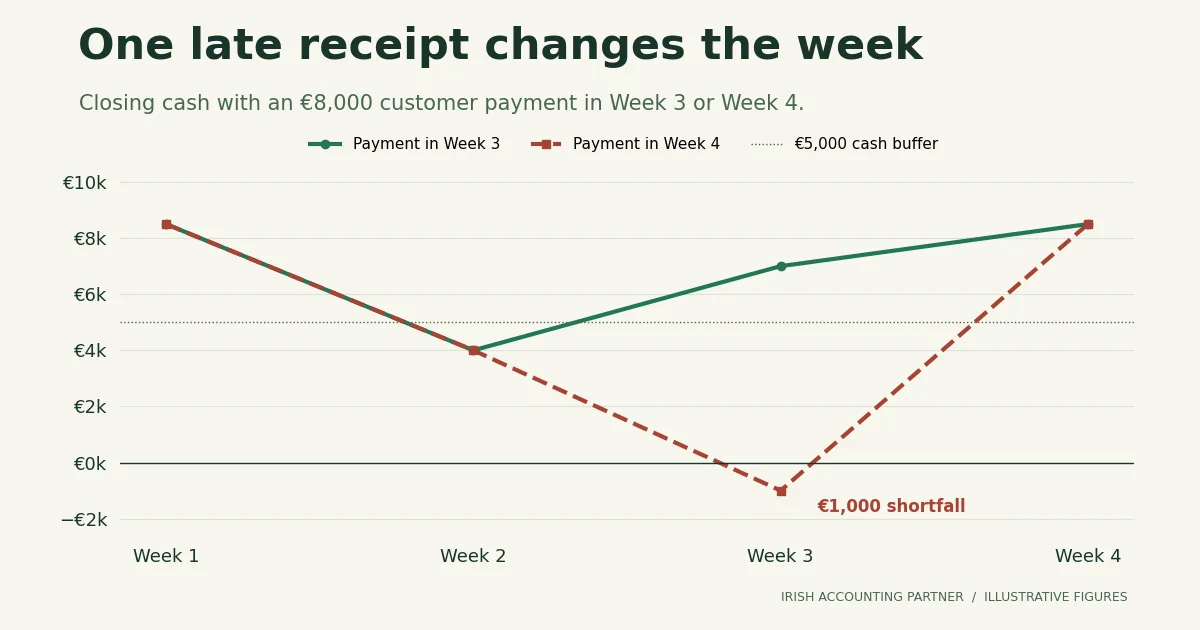
A business starts with €12,000 and aims to keep a €5,000 buffer. In the base case, Week 2 drops below the buffer to €4,000, and an €8,000 receipt restores closing cash to €7,000 in Week 3. In the Example tab, move the €8,000 invoice receipt from D11 to Week 4 in E11, adding it to the €4,000 receipt already there.
Week 3 closing cash then drops to −€1,000, and Week 4 still ends at €8,500. That is the distinction between a shortfall this week and a balance that recovers later. It gives you time to verify the payment date and decide whether to follow up, reschedule a discretionary purchase or discuss available funding.
Scroll sideways to see all columns on a narrow screen.
| Week | Closing cash, on-time payment | Closing cash, late payment |
|---|---|---|
| Week 1 | €8,500 | €8,500 |
| Week 2 | €4,000 | €4,000 |
| Week 3 | €7,000 | −€1,000 |
| Week 4 | €8,500 | €8,500 |
Roll the forecast forward every week
Keep a dated copy before updating. Compare last week’s forecast with the cash that actually cleared, then set the new Week 1 opening balance from the bank. Shift outstanding receipts and payments to their expected dates and add another week at the end.
Review the lowest closing balance, the first week below your buffer and the one or two assumptions that could change the picture most. Give each action an owner. Detailed estimates tend to be clearer in the next few weeks, so flag assumptions further out if the date or amount is uncertain.
When a weekly cash forecast is most useful
A weekly forecast is useful when upcoming payments cluster together, customer receipts are uneven or management needs to see whether there is time to act. For longer-range questions such as hiring capacity or a new location, use the weekly view alongside a monthly plan.
If the inputs need reconciling or you want the team to review a rolling forecast regularly, our cash flow forecasting services can connect the forecast to your reporting and financial planning. If you need to check which figures belong in the reporting pack, start with our management accounts guide.
See where cash could get tight
Tell us what you expect to collect, which outgoings are fixed and which payment dates you’re unsure about. We can discuss a useful forecast and review rhythm for the business.
Request a consultation